
For many small business owners, the search for group health insurance starts the same way.
You research options online, request various quotes, and begin comparing plans. At first glance, they can all seem similar.
And then, at some point, the process becomes less clear.
What most business owners don’t expect is that they can end up comparing entirely different types of group health insurance, each with its own nuances and considerations.
Level-funded plans from a major insurance company appear alongside their traditional options. A PEO quote looks different from an insurance carrier’s quote. An association plan shows up with unfamiliar terminology. Self-insured plans look interesting, but hard to grasp who carries the risk.
They all offer coverage. They all involve premiums, networks, and plan designs.
But once you dig deeper, overwhelm quickly builds.
You realize that one plan option requires underwriting, while another doesn’t. One platform requires additional coverages besides group health insurance, such as workers’ compensation, payroll, and other HR services, while another option offers coverage a la carte. Some have additional fees and costs on top of premium payments, while others’ total cost is the premium alone.
The structures behind each one are very different, and those structures play a major role in how the plan works and in calculating the total cost over time.
What Types of Group Health Insurance Options Do Small Businesses Typically See?
Most of the confusion stems from misunderstandings of the different types of group health insurance structures encountered during the search process.
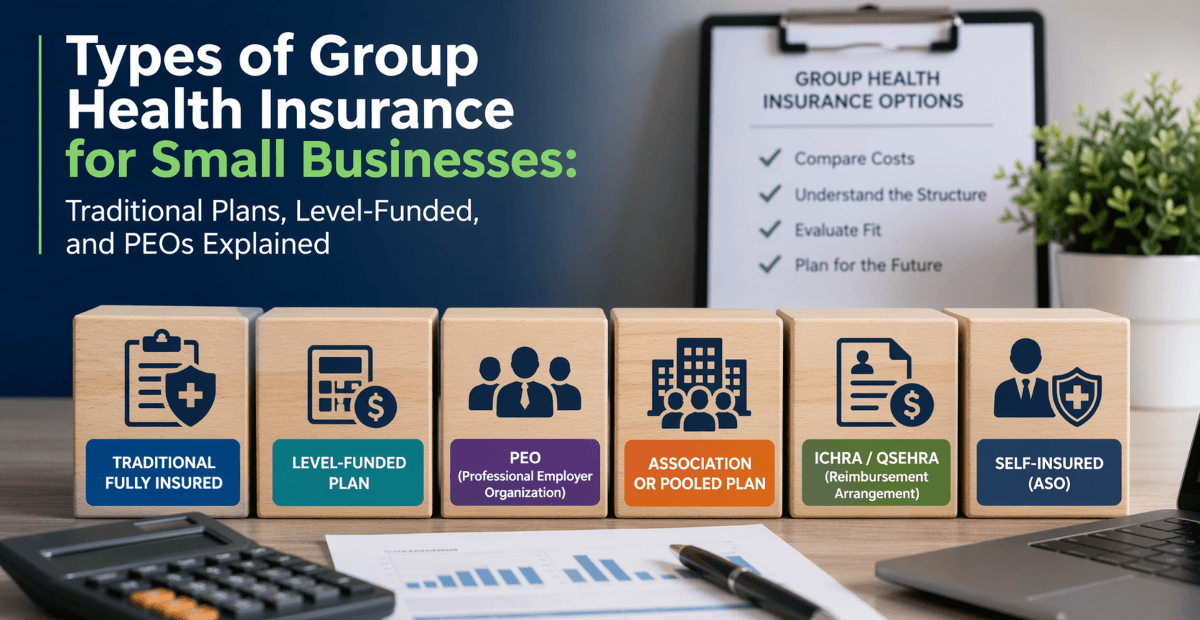
When small businesses begin exploring options, they’re usually encountering a mix of:
- Traditional fully insured plans through a carrier
- Level-funded health plans and other self-insured arrangements
- Professional Employer Organizations (PEOs)
- Association or pooled group plans
- Health reimbursement arrangements (ICHRA/QSEHRA)
Each of these approaches handles risk, pricing, and administration differently.
That’s where much of the confusion tends to come in.
What Is Traditional Group Health Insurance Through a Carrier?
Traditional group health insurance is a type of plan where a business works directly with a major insurance carrier to establish coverage.
These plans are typically:
- fully insured
- regulated at the state level
- more standardized in structure
From a business owner’s perspective, this approach often feels more straightforward.
There are fewer moving parts, and plan comparisons tend to be clearer.
That doesn’t make it better or worse, but it is often easier to evaluate at the outset.
What Is a Level-Funded Health Plan for Small Businesses?
A level-funded plan is a type of group health insurance that blends elements of fully insured and self-insured coverage.
With this structure:
- The employer pays a fixed monthly amount
- A portion goes toward expected claims
- Performance over time can influence long-term cost and potential refunds
Major carriers oftentimes quote both level-funded and traditional fully insured plans, depending on availability in each state. For example, level-funded plans are widely available to small employers in New Jersey and have become increasingly popular.
In New York, however, level-funded options are generally not available to small groups in the same way.
That difference can create confusion for businesses comparing information online, especially when resources don’t clearly distinguish between state availability.
What Is a PEO (Professional Employer Organization) for Health Insurance?
A PEO is one type of group health insurance arrangement that uses a co-employment structure.
In that setup:
- Employees are grouped into a larger pool across many businesses
- The PEO takes on certain administrative responsibilities
- Benefits, payroll, and HR functions are often bundled together
From a health insurance standpoint, this can provide access to:
- larger group pricing structures
- packaged administrative services
But it also means the business is entering into a broader relationship beyond just insurance.
For some companies, that’s the goal. For others, it can feel like more than they originally intended when they started looking for coverage.
What Is an Association or Group Purchasing Health Plan?
Association plans are a type of group health insurance arrangement that brings multiple employers together into a shared risk pool.
These plans are often structured as:
- level-funded or self-insured programs
- group purchasing arrangements across industries or organizations
They can offer:
- competitive pricing
- alternative plan structures
But they also introduce variables such as:
- how the broader pool performs
- how risk is shared across participants
- how pricing evolves over time
These factors are not always obvious when first reviewing quotes.
What Is an ICHRA or QSEHRA (Reimbursement-Based Health Plans)?
Some businesses come across options that are not traditional group health insurance plans at all.
Health reimbursement arrangements (such as ICHRA or QSEHRA) are a type of employer-funded approach where:
- employees purchase individual health insurance
- the employer reimburses a defined amount
- the business steps away from managing a group plan directly
These arrangements can work well in certain situations.
But they are structured very differently from group health insurance and entail their own considerations regarding compliance, employee experience, and long-term strategy.
What Is a Self-Insured (ASO) Health Plan?
A self-insured plan is a type of group health insurance arrangement where the employer takes on the financial risk of claims.
In these setups:
- A third party administers the plan
- The employer funds claims directly
- Stop-loss insurance is typically used for protection
These plans are more common as businesses grow, but they can appear during the research process and add another layer of complexity when comparing options.
What Are the Key Differences Between These Health Insurance Options?
The differences between these arrangements are not always about the benefits themselves.
They are about the structure behind the plan.
That includes:
- How risk is handled
- How pricing is determined
- How much control the employer has
- How the plan evolves over time
Two plans may look similar on paper but behave very differently because of how they are set up, which can affect how employer contributions influence participation and overall plan performance over time.
How Should a Small Business Decide Which Health Insurance Option Is Best?
This is usually the central question, and it doesn’t have a one-size-fits-all answer.
The right fit often depends on:
- Company size and growth plans
- Employee demographics
- Administrative preferences
- Comfort with cost variability
- Long-term benefits strategy
Some businesses prioritize predictability. Others are open to more flexibility.
Some want bundled services. Others prefer to keep things separate.
The structure that works well for one business may not feel like the right fit for another.
Why Does Comparing Group Health Insurance Options Feel So Confusing?
Most confusion comes from trying to compare these options as if they were the same.
But they are fundamentally different structures.
A PEO is not just an insurance plan.
A level-funded plan is not the same as a fully insured plan.
An ICHRA is not a group plan at all.
When these are presented side-by-side without context, the comparison becomes unclear.
That’s usually when decision-making becomes more difficult and not easier.
What Should Small Businesses Focus on When Evaluating Health Insurance Plans?
Rather than focusing only on price, it often helps to step back and ask:
- What type of structure is this?
- How does this plan function over time?
- What role will the business play in managing it?
- How might this change as the company grows?
Those questions tend to create more clarity than simply comparing premiums or deductibles.
A More Practical Way to Approach the Decision
None of these options is inherently right or wrong.
They are simply different ways of structuring group health insurance.
The challenge is that those differences are not always obvious when you first start researching.
Most business owners are making thoughtful decisions based on the information available to them.
The businesses that tend to feel most confident in their choice are those that take the time to understand not just the plan but the structure behind it.
If you’re exploring group health insurance options in New Jersey or New York, or comparing quotes across different types of plans, it can be helpful to look beyond the surface and understand how each option is set up.
That perspective tends to make the decision process much clearer.