
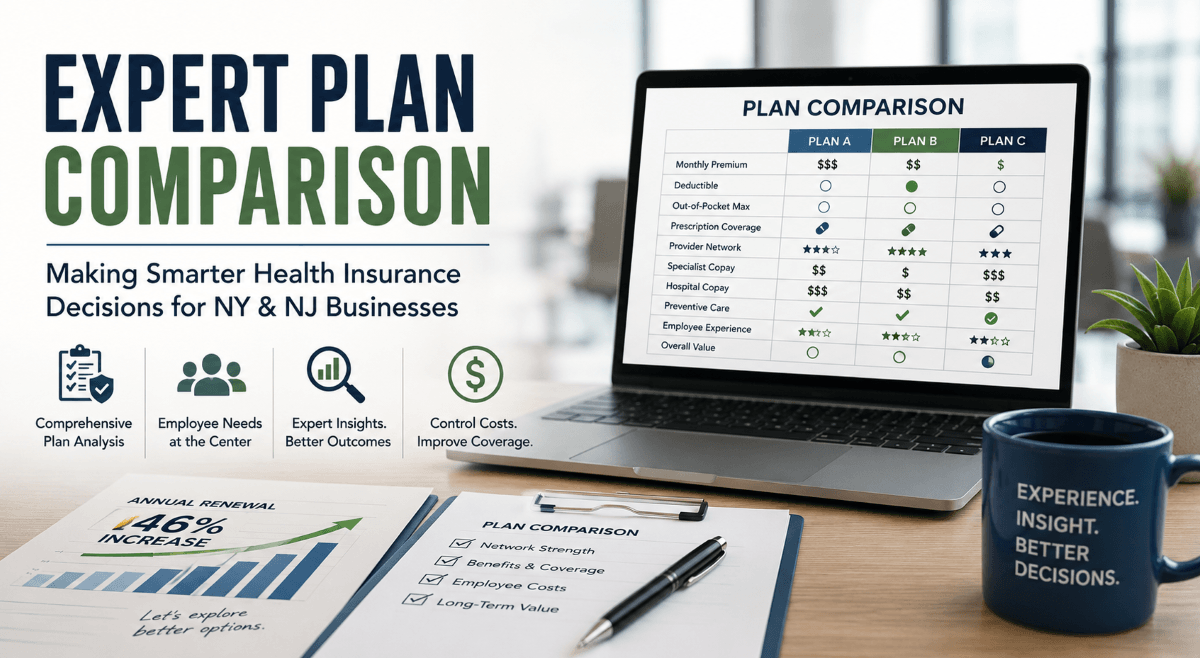
When most business owners compare health insurance plans, the first thing they look at is the premium.
That’s understandable.
Premiums are visible. They’re easy to compare. And when renewal rates arrive, they’re often the first number that gets everyone’s attention.
But an expert plan comparison goes much deeper than comparing monthly costs.
Over the years, we’ve found that many of the most important differences between plans only become clear when a business or employee is actually using the coverage.
That’s where working with an experienced employee benefits advisor can make a significant difference.
What Is an Expert Plan Comparison?
An expert plan comparison is the process of evaluating multiple group health insurance options beyond just premium costs.
A thorough comparison may include:
- Deductibles
- Copays
- Maximum out-of-pocket expenses
- Provider networks
- Prescription drug coverage
- Employee contribution strategies
- Funding arrangements
- Long-term renewal considerations
The goal is not simply to identify the lowest-cost plan.
The goal is to identify the plan that best fits the needs of the business and its employees.
A Real Example: A 46% Renewal Increase
Recently, a company received a renewal with a 46% premium increase.
The initial reaction was frustration and concern.
The assumption was that if one insurance carrier was increasing rates that much, every carrier would likely be expensive as well.
Fortunately, that wasn’t the case.
After conducting a detailed plan comparison and reviewing alternative carriers, we found a similar plan with premiums that were actually lower than what the company had been paying before the increase was ever proposed.
What made the difference?
Different insurance carriers evaluated the same group differently.
Without a comprehensive comparison, the company may never have known those alternatives existed.
Many business owners are surprised to learn how much guidance can be available throughout the year beyond simply obtaining quotes and renewal rates. In fact, one of the most common misconceptions we encounter is discussed in our article, “What Many Businesses Don’t Realize About Group Health Insurance Brokers.”
Looking Beyond the Premium
One of the most common mistakes businesses make is focusing exclusively on monthly premiums.
While premiums are important, they are only one piece of the overall cost equation.
Consider an employee who regularly visits specialists, fills ongoing prescriptions, or manages a chronic medical condition.
A lower premium plan may initially appear attractive, but higher deductibles, copays, or prescription costs could ultimately create a more expensive experience.
An expert comparison evaluates both employer costs and employee costs together.
In some cases, an expert plan comparison may also involve evaluating different funding arrangements, not just different insurance carriers. Businesses considering alternatives to traditional group health insurance can learn more in our article, “Types of Group Health Insurance for Small Businesses: Traditional Plans, Level-Funded, and PEOs Explained.”
Real-Life Decisions Often Happen Under Pressure
Another situation involved a business owner whose son needed surgery following a sports injury.
The surgeon he initially wanted to use was out-of-network.
His concern wasn’t simply cost.
His concern was finding the best possible surgeon.
After reviewing the available options, he discovered highly qualified in-network providers that delivered the same confidence while significantly reducing potential out-of-pocket expenses.
Situations like this highlight an important reality:
The value of a health plan often becomes most apparent when major decisions need to be made quickly.
The Questions Most Businesses Don’t Think to Ask
When reviewing plans, business owners often focus on:
- Premiums
- Deductibles
- Employee contributions
Those are important.
But an expert plan comparison also asks:
- How broad is the provider network?
- How are specialty medications covered?
- How might this plan perform for employees with ongoing medical needs?
- What happens if a major claim occurs?
- How does this compare to alternative funding strategies?
These questions can significantly impact employee satisfaction and long-term costs.
Why Experience Matters
Health insurance plans can look very similar on paper. In practice, they can function very differently.
The most valuable comparisons often come from understanding how plans perform in real-world situations rather than simply comparing benefits summaries side by side.
An experienced advisor can help identify differences that may not be obvious during the quoting process but become very important later.
Final Thoughts
An expert plan comparison is about much more than finding the lowest premium.
It’s about understanding how a plan fits the business, how employees will experience the coverage, and how different options may perform when real-life situations arise.
For businesses in New Jersey and New York, taking the time to conduct a thorough comparison can lead to better decisions, greater confidence, and fewer surprises throughout the year.