
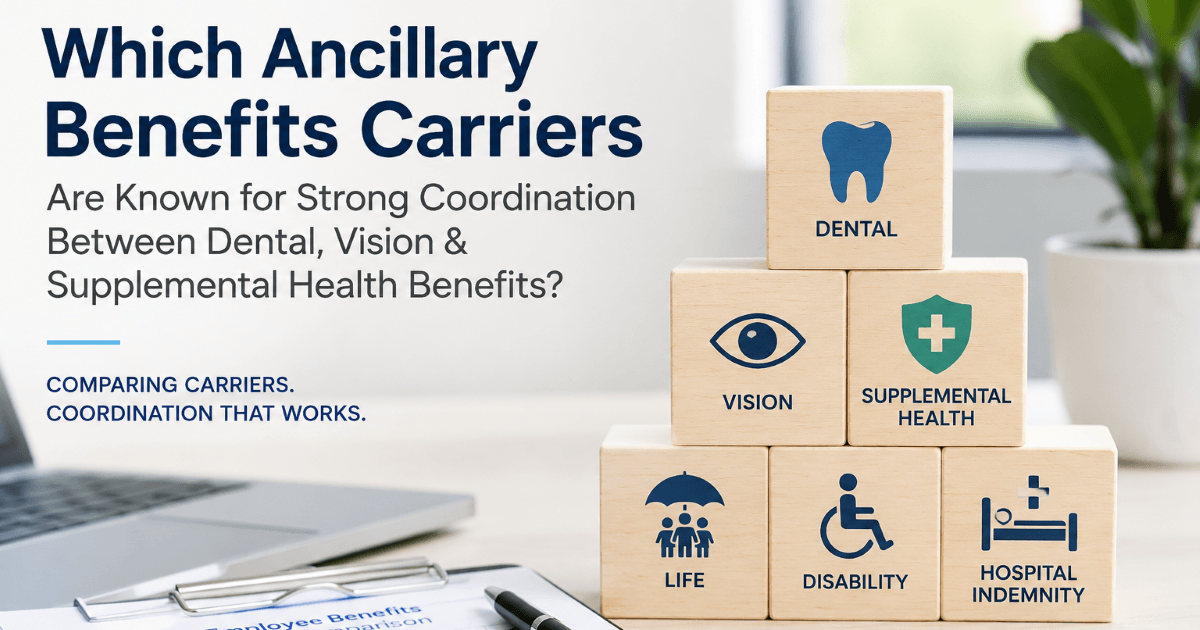
For many small and mid-sized businesses, ancillary benefits are often added one product at a time.
Dental gets reviewed during one renewal cycle. Vision is added later. Supplemental health benefits such as accident, critical illness, hospital indemnity, or disability insurance may come up separately after another conversation.
Over time, it’s common for employers to end up with multiple carriers handling different pieces of the benefits package. That approach is not necessarily wrong. In many cases, it happens naturally as businesses grow.
But as employee benefits become more important to hiring, retention, enrollment experience, and ongoing administration, more employers start asking a different question:
Which ancillary benefits carriers are known for strong coordination across dental, vision, and supplemental health benefits?
That question usually starts to come up when businesses begin experiencing:
- multiple enrollment systems
- inconsistent employee experiences
- separate service teams
- disconnected billing processes
- different eligibility rules across products
- or difficulty explaining benefits clearly during onboarding
At that point, employers are often no longer evaluating ancillary benefits as isolated products. They’re evaluating the overall benefits experience.
What Are Ancillary Benefits?
Ancillary benefits are employee benefits offered alongside major medical or group health insurance.
These benefits often include:
- Dental insurance
- Vision insurance
- Life insurance
- Disability insurance
- Accident insurance
- Critical illness insurance
- Hospital indemnity insurance
- Other voluntary or supplemental health benefits
For many employers, ancillary benefits help round out the overall employee benefits strategy while also improving employee perception of the benefits package.
In some cases, employees may interact with these benefits more frequently than their medical insurance.
Dental and vision claims, for example, tend to be highly visible to employees because they are used more routinely.
That visibility can shape how employees perceive the overall quality and coordination of the employer’s benefits offering.
Why Does Coordination Between Ancillary Benefits Matter?
At first glance, it may seem like separate benefits can simply operate independently.
And in some situations, they can.
But over time, employers often realize that the structure behind ancillary benefits can affect:
- employee experience
- enrollment simplicity
- administration workload
- billing coordination
- eligibility tracking
- payroll integration
- claims communication
- and overall benefits perception
When multiple benefits are coordinated well together, employees often experience:
- fewer administrative frustrations
- simpler enrollment processes
- more consistent communication
- and a clearer understanding of what benefits they actually have
From the employer’s perspective, stronger coordination can also reduce ongoing friction during onboarding, renewals, employee changes, and day-to-day administration.
What Does “Strong Coordination” Between Ancillary Benefits Actually Mean?
When employers search for the best ancillary benefits carriers, they are often not just looking for pricing. They are trying to understand which carriers create a smoother overall experience.
Strong coordination between dental, vision, and supplemental benefits can include:
- unified enrollment platforms
- consolidated billing
- integrated eligibility management
- bundled customer service teams
- streamlined claims experiences
- connected online portals
- coordinated implementation processes
- and easier employee communication
In some cases, employers also prefer having a smaller number of carrier relationships to manage.
That does not automatically mean a single carrier is always the best solution. But it is one of the reasons employers often explore bundled ancillary benefits arrangements.
Which Ancillary Benefits Carriers Are Often Known for Strong Coordination?
Different carriers tend to have different strengths.
Some are known for stronger disability management. Others are known for integrated enrollment systems, voluntary benefits, or strong dental networks.
Among small and mid-sized businesses, several carriers are frequently recognized for offering coordinated ancillary benefits solutions across multiple product lines.
Is Guardian Known for Coordinated Ancillary Benefits?
Many employers associate Guardian with strong dental and disability insurance offerings, particularly in the small-to-mid-sized market.
Guardian is also commonly recognized for:
- integrated ancillary product offerings
- voluntary benefits coordination
- disability and life insurance integration
- and bundled enrollment experiences
For employers looking to consolidate multiple ancillary benefits under one carrier, Guardian is often part of the conversation.
Is MetLife Known for Bundled Dental, Vision, and Supplemental Benefits?
MetLife is another carrier frequently considered when employers want broader ancillary benefits coordination.
The carrier offers:
- dental insurance
- vision insurance
- life insurance
- disability insurance
- accident and critical illness coverage
- and other supplemental health products
Many employers evaluating MetLife are looking at the ability to coordinate multiple benefits within a single platform and enrollment structure.
For businesses with growing workforces or more complex onboarding needs, administrative coordination can become just as important as the individual products themselves.
Is Principal a Strong Ancillary Benefits Carrier?
Principal is often recognized among employers for combining ancillary benefits with broader financial wellness and retirement services.
From an employee benefits perspective, Principal commonly offers:
- dental and vision insurance
- life and disability insurance
- voluntary benefits
- integrated enrollment systems
- and administrative coordination across products
Some employers value the ability to align benefits and retirement-related services under a more connected structure.
What About Sun Life, The Standard, Unum, and Other Supplemental Benefits Carriers?
Some ancillary benefits carriers are especially well known for offering broad portfolios of supplemental health, disability, life, and voluntary benefits products.
Carriers such as Sun Life, The Standard, and Unum are frequently quoted among small and mid-sized businesses because they offer a wide range of ancillary benefits solutions and are widely recognized within the employee benefits market.
Each carrier also tends to have product areas where they may be particularly competitive, whether based on pricing, underwriting approach, administrative capabilities, or overall product structure.
That’s one reason why many employers end up reviewing multiple ancillary benefits carriers during the quoting process.
The most competitive overall fit can vary depending on factors such as:
- group size
- industry
- employee demographics
- location
- and the specific mix of benefits being offered
In some cases, the conversation becomes less about finding a single “best” carrier and more about determining which combination of products, pricing, and administrative coordination aligns best with the business overall.
Should Small Businesses Use One Carrier for All Ancillary Benefits?
This is one of the most common questions employers ask.
And like many employee benefits decisions, there is not always a universal answer.
Using one carrier for dental, vision, life, disability, and supplemental health benefits can create:
- simpler administration
- consolidated billing
- easier onboarding
- and a more unified employee experience
But there can also be situations where:
- one carrier has stronger dental networks
- another offers better disability management
- a carrier has competitive rates for one product but as much for the others being offered
That is why many businesses end up balancing:
- administrative simplicity
- employee experience
- network quality
- pricing
- and long-term flexibility
What Should Employers Look for When Comparing Ancillary Benefits Carriers?
When employers evaluate ancillary benefits carriers, pricing is often only one part of the conversation.
Other considerations can include:
How coordinated is the enrollment process?
Some carriers offer more unified enrollment and implementation systems than others.
How easy is the administration process for HR teams?
Employers often underestimate how much day-to-day administration can vary between carriers.
How well do the benefits integrate together?
Some carriers are designed around bundled ancillary benefits strategies, while others operate more independently by product line.
How strong are the provider networks?
Dental and vision network access can significantly affect employee satisfaction.
How does the employee experience feel?
Employees tend to notice when benefits feel disconnected, difficult to access, or hard to understand.
Why Ancillary Benefits Strategy Has Become More Important
In the past, many businesses viewed ancillary benefits as secondary to medical insurance.
Today, that perspective has started to shift.
Employees often evaluate:
- dental coverage
- vision benefits
- disability insurance
- and voluntary benefits
as part of the overall quality of the employer’s benefits package.
As businesses compete for talent, improve retention, and support remote or hybrid workforces, the coordination behind those benefits tends to matter more than it once did.
That does not mean every employer needs a fully consolidated carrier arrangement.
But it does mean that the overall employee experience has become a more important part of the decision-making process.
Are Bundled Ancillary Benefits Always Better?
Not necessarily.
In some situations, bundling ancillary benefits under one carrier creates a smoother experience.
In others, separating carriers may provide:
- stronger networks
- more competitive pricing
- better plan flexibility
- or specialized expertise
The key is usually understanding the trade-offs.
A lower-cost arrangement may create more administrative complexity.
A highly coordinated arrangement may simplify enrollment but limit flexibility in certain product areas.
The right fit often depends on:
- company size
- workforce demographics
- internal HR resources
- growth plans
- and how important administrative coordination is to the organization.
A More Practical Way to Evaluate Ancillary Benefits Carriers
Most employers are not just trying to buy dental insurance or vision insurance.
They are trying to create a benefits structure that works well for both the business and the employees using it.
That is why ancillary benefits conversations increasingly go beyond premiums and plan summaries.
The coordination between products, systems, enrollment processes, and employee experience often becomes just as important as the individual benefits themselves.
The businesses that tend to feel most confident in their ancillary benefits strategy are usually the ones evaluating:
- how the benefits work together
- how employees experience them
- and how the structure supports the business over time
rather than evaluating each product entirely in isolation.
If you are comparing ancillary benefits carriers or reviewing options for dental, vision, life, disability, or supplemental health benefits, it can help to look beyond individual products and evaluate how the overall structure functions together.
That perspective tends to make the decision-making process much clearer.