
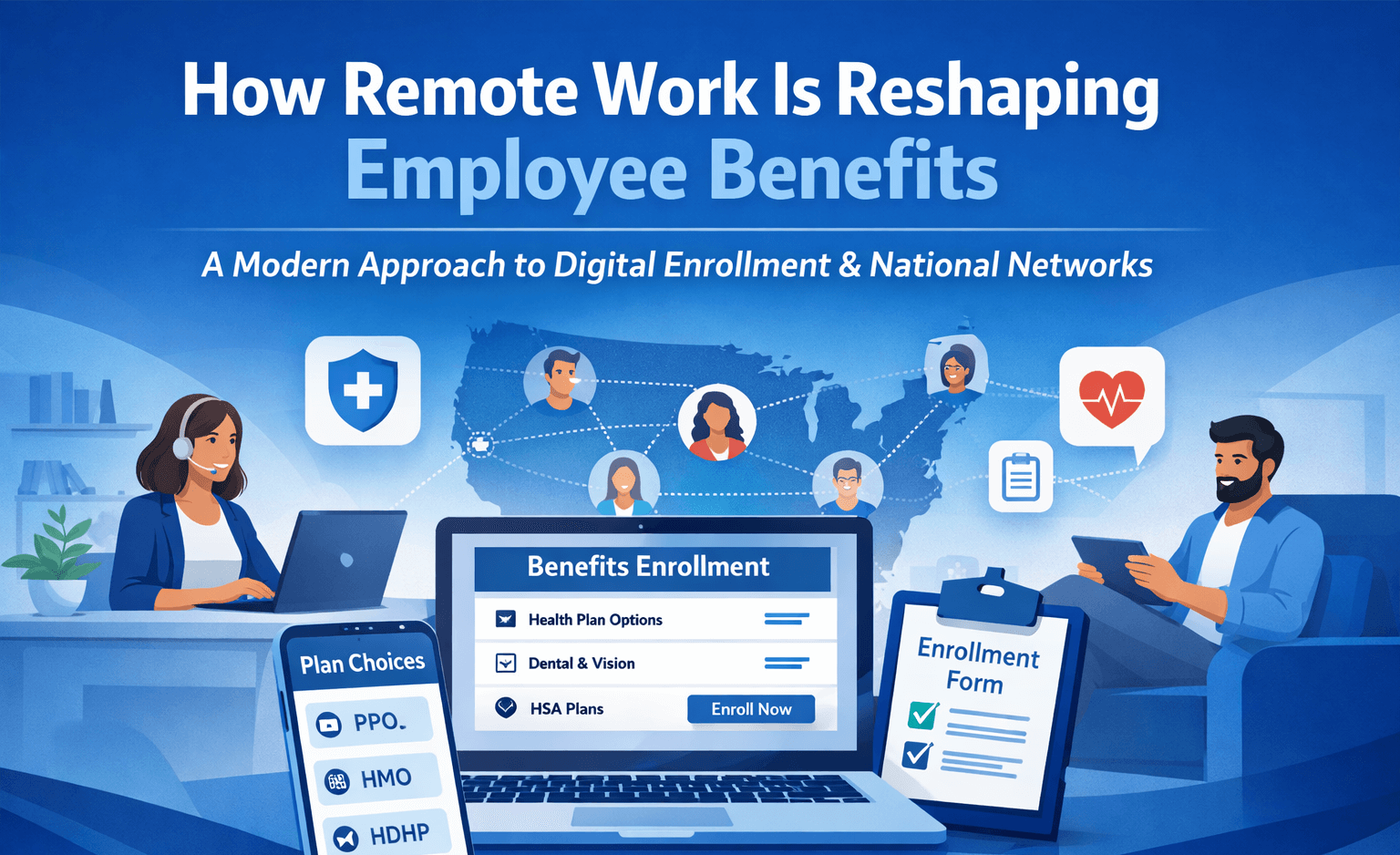
Remote and hybrid work have evolved from temporary pandemic solutions into permanent workforce strategies.
For small and mid-sized businesses, particularly in NJ and NY, this shift has fundamentally changed how companies design, communicate, and administer employee benefits.
As advisors managing group health insurance and ancillary benefits for distributed teams, we’ve seen how remote hiring affects everything from health plan selection to enrollment processes and multi-state compliance.
What used to be an in-office enrollment meeting with paper forms is now a digital-first experience that must function seamlessly for employees who may never step inside a physical office.
Below, we outline how remote work is reshaping employee benefits strategy, and what employers must do to keep up.
The Continued Growth of Remote Work in Small and Mid-Sized Businesses
Remote work is no longer an experiment.
Recent workforce research shows:
- Roughly one-third of U.S. employees work remotely at least part-time
- Remote job postings remain significantly above pre-pandemic levels
- A majority of employers now view remote hiring as a strategic advantage
- Many small businesses hire fully remote employees in at least one role
For employers, remote hiring expands access to talent, accelerates recruiting timelines, and supports employee satisfaction. But it also introduces structural changes, particularly in how employee benefits are delivered and administered.
Why Remote Hiring Changes Group Health Insurance Decisions
When employees all worked locally, group health insurance plans were often selected based on regional provider networks. With remote teams spread across multiple states, that approach no longer works. Group health insurance for remote employees requires broader access, stronger network flexibility, and careful attention to compliance.
Employers must now consider:
- Whether employees can easily find in-network providers across state lines
- How out-of-state hires affect plan participation requirements
- Multi-state insurance regulations and payroll coordination
Remote hiring has turned health plan selection into a strategic workforce decision rather than a traditional cost-comparison exercise.
Why National Health Insurance Networks Matter for Remote Employees
National PPO and broad-access EPO networks have become increasingly important for distributed teams.
When employees live in different states:
- Regional network plans may not provide adequate access
- Provider network limitations can create frustration and low overall participation
- Employers risk offering benefits that unintentionally disadvantage remote hires
National networks and level-funded plans with broad access give employers hiring flexibility without geographic restrictions. For companies recruiting nationwide, this structure supports both growth and employee experience.
Expanding Health Plan Options for a Geographically Diverse Workforce
Remote teams often mean diverse employee needs.
Employers are increasingly requesting:
- Multiple plan tiers
- HSA-compatible options
- Varying deductible structures
- Plans that accommodate different family situations
Designing flexible health benefits for remote employees improves both attraction and retention, particularly when hiring across different cost-of-living regions.
But plan design is only half the equation. Communication and enrollment must also evolve.
Why Digital Benefits Enrollment Is Now Essential for Remote Teams
The traditional in-office enrollment meeting no longer scales.
Remote employees:
- Do not pick up paper packets
- Expect mobile-friendly access
- Want on-demand plan comparisons
- Prefer digital forms over physical paperwork
Digital benefits enrollment platforms are now foundational to supporting remote and hybrid teams. Employers that fail to modernize enrollment risk confusion, delays, and administrative inefficiencies.
Modernizing Benefits Administration for a Remote Workforce
To create a seamless employee benefits experience, employers are increasingly implementing:
1. Digital Enrollment Kits
Customized online materials that include:
- Plan summaries
- Network links
- Cost breakdowns
- Enrollment instructions
- Video explanations when needed
2. Benefits Administration (BenAdmin) Platforms
These systems:
- Preload plan options
- Provide side-by-side comparisons
- Capture electronic enrollments and waivers
- Track completion status
- Reduce manual paperwork
3. Virtual Enrollment Support
Including:
- Remote benefits meetings
- One-on-one consultations
- Language support when necessary
- Automated deadline reminders
This digital-first benefits administration approach reduces friction for both HR teams and remote employees.
The Future of Remote Work and Employee Benefits Strategy
Remote work is not reversing. It is here to stay.
As distributed teams become standard, employers will continue shifting toward:
- National health insurance networks
- Digital benefits enrollment platforms
- Seamless onboarding systems
- Flexible, scalable plan designs
Employee experience increasingly depends on how easily benefits can be understood, accessed, and managed. In a competitive hiring market, friction in benefits enrollment can directly impact perception and retention.
Is Your Employee Benefits Strategy Built for a Remote Workforce?
Remote work has reshaped employee benefits. Companies that adapt quickly gain advantages in recruiting, retention, and administrative efficiency. Those that cling to outdated enrollment processes or narrow plan designs risk creating unnecessary barriers for distributed teams.
A modern employee benefits strategy for remote workers includes:
- Broad network access
- Flexible plan options
- Digital enrollment tools
- Structured compliance processes
- Clear communication
If your organization is hiring remote or hybrid employees, your benefits structure should reflect that reality.
If you’d like to evaluate how your group health insurance and enrollment systems support remote teams, we’re always happy to walk through best practices and plan options aligned with long-term growth.